Who’s Driving This Body?
What part of us is actually us? This question has been tickling the back of my brain lately, like a curious worker bee rummaging through the sweet nectar of consciousness. If we can change — if circumstances can sculpt us like emotional Play-Doh — then what’s the constant? What’s our “control variable,” as they say in science experiments? Is it our personality? Our soul? And if so, can the two be separated, or are they like peanut butter and jelly — distinct but doomed to cling?
I started asking this question because of my brother Mark. My oldest brother — who, before his accident, was all stern brows and sharp edges — suffered a traumatic brain injury that left him unable to walk, talk, or eat. He had to relearn how to be human, which, if we’re honest, most of us could use a refresher course on anyway. He had been a father, a husband, a man of quiet authority. After the accident, he was... different. Not worse. Not broken. Just different — softer, funnier, louder, more himself, somehow.
Before he hit a tree going 70 miles per hour, Mark and I weren’t particularly close. Afterward, we became like peas and carrots. I was 13 when it happened — that messy age where everything feels like it’s happening to you, even if it isn’t. Because I was home-schooled shortly after, I helped my mom with his rehabilitation every day. And I got to meet a new version of my brother — or perhaps the truest one. The accident stripped away his rigid shell and revealed a man I adored: disarming, funny, childlike, wise.
It made me wonder: Who are we, really? Are we just the sum of what’s happened to us? Can a car crash change a person’s personality but leave the soul untouched? Neuroscience offers an eerie little confirmation: according to a 2019 study in Nature Neuroscience, even mild brain injuries can alter social behavior and emotional regulation, suggesting that our sense of “self” is more like software than sacred scripture. But maybe — just maybe — the soul is the hard drive that never erases, no matter what data gets corrupted.
Interestingly, psychology has its own twist on this. A 2017 study from the Journal of Personality and Social Psychology found that people who believe in a stable, unchanging “core self” tend to recover from trauma more resiliently than those who view identity as purely situational. In other words, the simple belief that something essential in us endures — even if we can’t define it — can anchor us through the chaos of change. Science, meet spirituality: apparently, both agree we need a steady place to stand, even if the floor keeps moving.
So here’s the thought experiment I invite you into: imagine your “best self.” The kids are thriving. You’re saving money. Your partner is affirming. Your job is rewarding. Your outfit looks great. Who are you then? Now flip it. The kids are fighting. Your partner feels like a cosmic test of endurance. Your boss thinks you’re the intern. Who are you now?
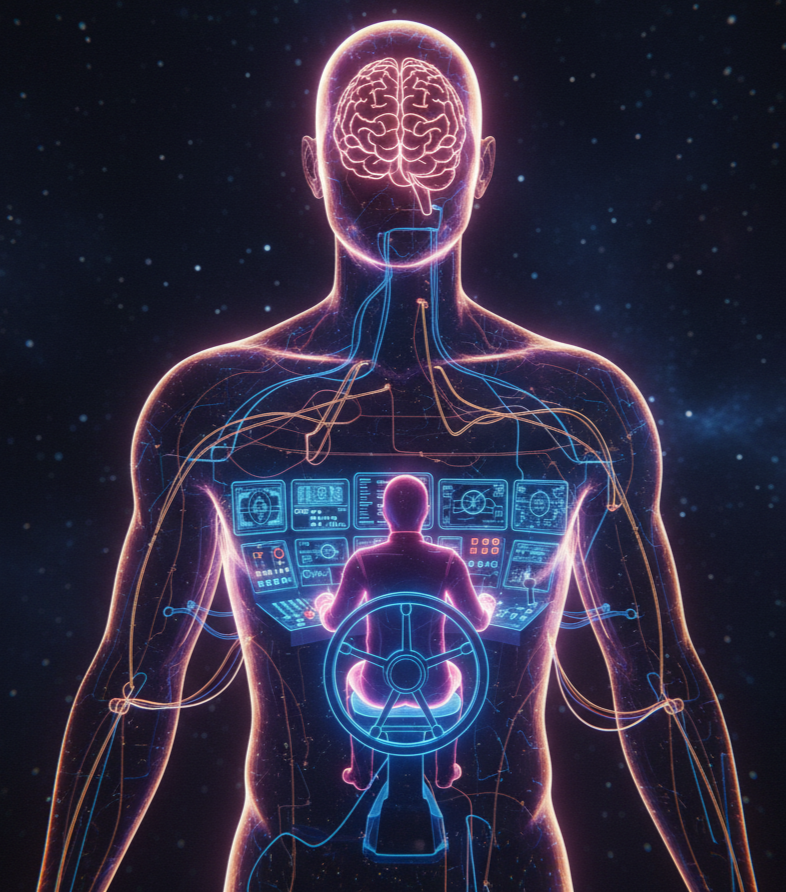
If your “you” changes depending on the storm, then who’s at the wheel? My theory — equal parts poetic revelation and caffeine logic — is that we are not what we think we are. We are what we do. What we consistently do. Because our actions are the mirror of our beliefs, and belief — real belief — cannot exist without evidence in motion.
Belief without behavior is just a Pinterest board. Belief with behavior is identity. If you believe you’re a peaceful person, your words, posture, and dinner-table patience will show it. If you believe you’re disciplined, your calendar will back you up.
Belief is a verb, not a vibe. It’s impossible to truly believe something and not act on it, just as it’s impossible to walk past a mirror and not see your reflection.
So if you want to know who you really are, don’t check your horoscope. Check your habits. The truest version of “you” is hiding in plain sight — in the things you do on autopilot, in the choices you make when no one’s grading you. Like Pocahontas said (and honestly, she nailed it): you can’t step in the same river twice.

You are not the same person you were last week, and thank God for that. The goal, then, isn’t to find the unchanging “you.” The goal is to build the kind of life that lets you evolve toward your higher expression — one action at a time.
So, dear reader, what do you believe about yourself? And how is it showing up in the wild experiment that is your life? Because whether you call it your soul, your mind, or your mitochondria, the truest test of who you are isn’t what you say — it’s what you do when you think no one’s watching.
Maybe the beauty of being human isn’t in discovering some fixed, eternal “me,” but in realizing we were never meant to be one thing at all. We’re shapeshifters in sensible shoes — growing, grieving, recalibrating with every heartbreak, miracle, and Tuesday afternoon. The self isn’t a sculpture to be finished; it’s a garden to be tended. Some seasons, you bloom wildly. Others, you’re just trying not to be eaten by metaphorical squirrels. But if you can keep showing up — planting better seeds, pulling the weeds of old stories, watering the faith that you can still grow — you begin to see that identity isn’t about arriving somewhere; it’s about learning how to stay curious on the way.
And that, perhaps, is the quiet miracle my brother taught me without ever meaning to. After his accident, he didn’t “get back” to who he was. He became who he could be — freer, kinder, lighter. Watching that unfold changed how I see everything, including myself. Maybe the soul isn’t the unmovable core; maybe it’s the permission to change. To believe differently. To love better. To forgive yourself for not being finished yet. Because you’re not supposed to be. The self, it turns out, is less like a portrait and more like a river — and the point isn’t to stay the same, but to keep flowing toward something truer.
Somewhere along this wandering thought trail, I realized that me — the “Maria” I think I am — is really just a collection of actions. Tiny behaviors strung together like fairy lights, flickering on and off, forming what we call a mind. But the mind, as holy and dramatic as we like to make it, is still a piece of meat. A magnificent, miraculous, overachieving organ, yes — but when we die, it becomes just that: an organ. Quiet. Heavy. No more than the heart or the lungs. So if the mind can die, and yet something in us still feels eternal, then what is it that continues? Who is the person that lives beyond action — beyond the firing synapses and recycled breath? That’s where the soul walks in, not with thunder and trumpets, but barefoot and familiar, like it’s been waiting patiently for us to remember.

There’s a part of you — of all of us — that doesn’t move with the current. It’s the riverbank that gives shape to the flow. It’s the unteachable, unkillable essence that was formed before the foundations of the earth, before you ever had a name or a story or a to-do list. You can glimpse it sometimes — in your laugh that sounds the same in every era of your life, in the way you tilt your head when you’re listening deeply, in the things that have always fascinated you for no logical reason. That part of you doesn’t need improvement. Don’t ever trade it, upgrade it, or edit it to fit the times. The world will always try to convince you to flow differently — faster, trendier, more productively — but hold tight to your riverbank. Because that quiet, immovable piece of you? That’s the soul that keeps watch while everything else learns, breaks, rebuilds, and flows on. And maybe — just maybe — that’s the real you we’ve been trying to find all along.
Until next time,
Maria 🌹